Le Cheval d'Or, and being the right audience for a restaurant
A meal at the Parisian culinary darling

Who is a restaurant for? The obvious answer is their customers—but I’m not so sure that’s always the case. Today, a restaurant may want to prioritize appealing to critics, their peers, the Michelin enterprise, or the pervasive lens of social media. Even those who are committed to serving their customers first have a specific clientele in mind—people of a certain socioeconomic status, say, or cultural background. Every brand has its target audience; a restaurant is no exception. As diners, we keep making the mistake of assuming that restaurants are for everyone.
When I walked out of Le Cheval d’Or in Paris, I knew they weren’t cooking for me. It broke my heart, in a way. A meal I’d looked forward to for months, recommended with gusto by everyone from the food writers I follow to the friends in my DMs. Modern French-Chinese cooking, they’d said, set in a traditional restaurant chinois near Belleville, a neighbourhood that many in the Chinese diaspora have called home for decades.
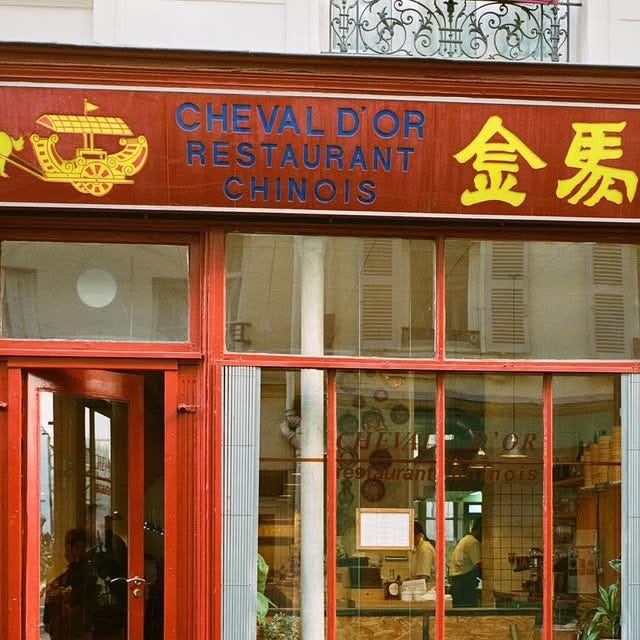
In theory, right up my alley. In practice, it was something else: loosely Chinese flavours and ideas adapted for the French palate.
We did the Gold tasting menu, which was 9 blind courses. The push and pull of fusion was present in every dish: a soy-drizzled tofu and egg custard served in an eggshell, an homage to a dish from The French Laundry; scallops on the half-shell, camouflaged among rice cakes, in a ginger-scallion sauce; mushroom spring rolls paired with a truffle dipping sauce.
Some dishes tackled more obvious culinary conventions. The shrimp toast was a take on a croque madame—served with a bechamel-like sauce and an egg topped with neutral chilli crisp. The tortellini was stuffed with tofu and served in a mild mapo moat. Then came the heavy-hitter of the night: a hybrid of Peking duck and duck à l’orange, served with chun bing, pickles, and a Christmasy hoisin sauce.


Delivering on the French-Chinese promise, I thought to myself. My fault for expecting a specific weighting and execution.
You might be wondering what was wrong with the food. Nothing, admittedly. Cooked with precision (the way the French have perfected), presented with care, served on time. Subtle, delicate, pleasant from end to end. All I have to go on is a feeling: that the dishes were conceptual ghosts, not lived experiences. I was eating fusion for fusion’s sake. To a diner uninterested in the history of food, the meal might not have stood out as Chinese, or even French.
Would I have felt differently if the team had communicated their point of view? Maybe. Instead, the dishes were served with little preamble or context, brought over by front-of-house staff who had not been trained on the matter. When I asked what went into the sauce for the egg cups, my server left and came back with a clear answer: soy. “Right,” I said, “And what else?” It was sweet, multidimensional and lent the dish all of its depth. She said she’d find out. She never did, nor did she answer any of my subsequent questions beyond the obvious. My fault for asking for the story when they were just there to serve the product.
Many reviews of Le Cheval d’Or celebrate the creativity of their dishes, which you can see in this menu. Yet the instinct is often to highlight the restaurant’s innovation by denigrating the cuisine that it’s built on, the cultural ideas it benefits from. One reviewer recommended it as a way of getting “off the beaten track of bad Asian cuisine.” Another suggested that calling it a Chinese restaurant “would be reductive,” as though there is anything reductive about one of the richest, oldest cuisines in the world. As though Chinese food needed the French touch to become worthy of attention.
You have to be careful with fusion. You might slip into the delusion that other cultures need saving.


That night, J and I were seated next to a Parisian couple who had a very different experience. C’est dingue, they said, over and over, mind-blown as they tasted the same dishes that we thought lacked flavour. I was glad to be reminded of this vantage point. They discussed wanting to take a trip to Pékin et Tokyo, how it’s the right time, since Asia is so developed now. It was evident from the way they processed what they were tasting that they didn’t have much experience with Chinese food. And in that way, Le Cheval d’Or might have been the perfect restaurant for them.
I say this without a sense of superiority. You can’t believe in the vertical hierarchies of taste when you know the multiverses of subjectivity exist. If anything, I’d forgotten where I was. Of course, it should appeal to the French diner first. I wouldn’t hold a vegan restaurant to the same standards of richness as a barbecue joint; I shouldn’t expect a Parisian restaurant to serve Chinese food that satisfies a Torontonian. Here, fusion is a way of life—no longer a claim to fame.
So yes, I was the architect of my own disappointment. Is there any way around it? The hyperbolic ecosystem of food reviews leaves little room for nuance or affordances for personal taste. The only way to vet a restaurant is to go, and even then, our biases compound: What accolades did the restaurant receive? Who recommended it? How much did we spend on it? The more we’ve spent on something, the higher we tend to perceive its value. I have gaslit myself into liking a meal more than once, because the alternative wasn’t as digestible.
How can today’s diners be fair to restaurants while being truthful to their own experiences? Where is the middleground between a rave review and a teardown? It’s a shame that a single visit can be a dealbreaker, that so many of our opinions are formed this way. But what choice do we have? Most of us cannot afford the repeat visits required to fully experience a restaurant, to “earn” our right to critique. The most we can say is that it wasn’t for us. Or, more accurately, that we weren’t for each other.
Le Cheval d’Or
21 Rue de la Villette
Paris
This is the food writing I am seeking! Loved reading this.